Friday, January 6, 2012

Uh Huh

Photobucket

Jennifer & Heather in agreeance at Messy & Jerry's wedding.

Thursday, January 5, 2012

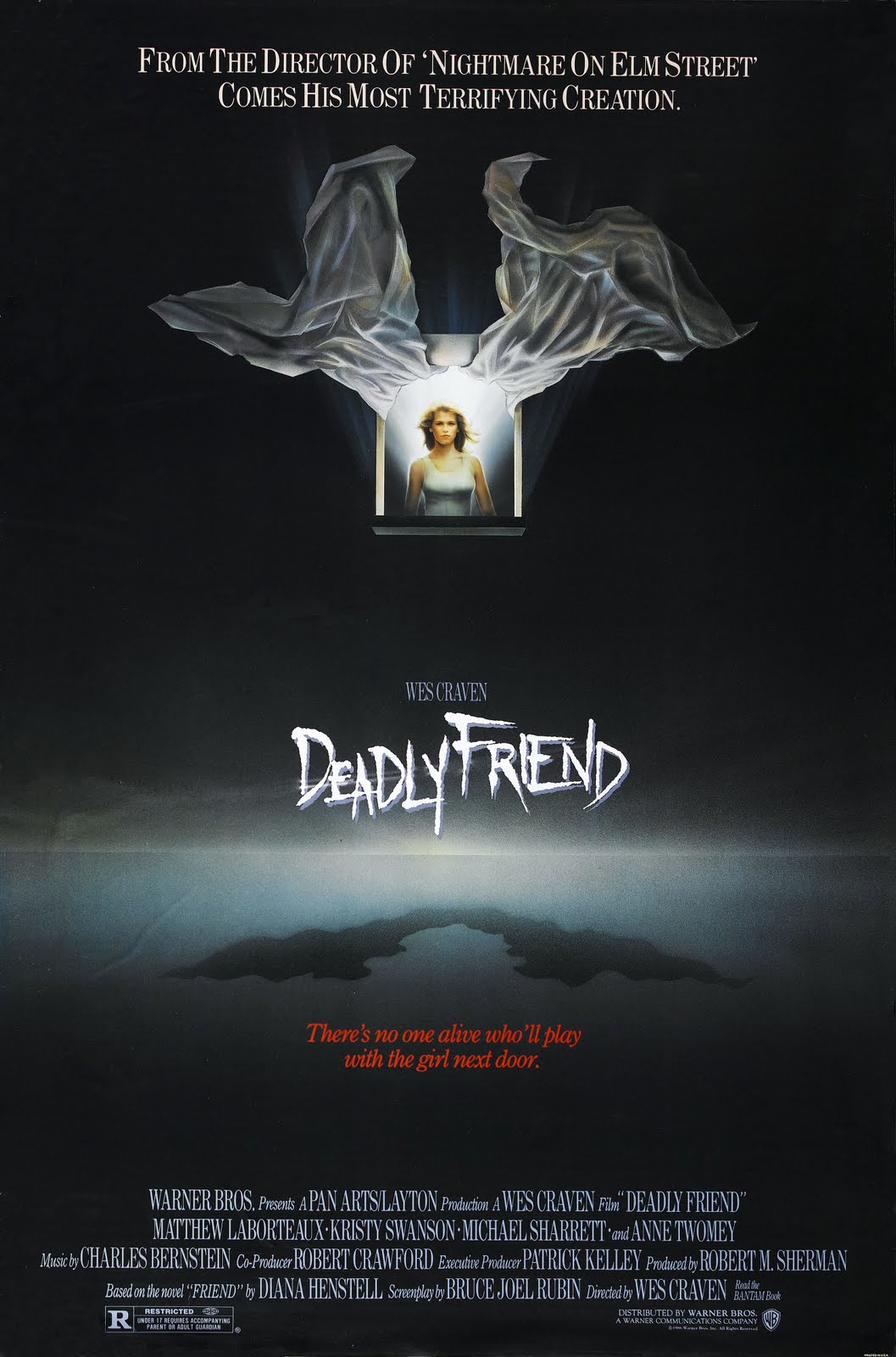
Deadly Friend (1986)


First movie of 2012 (for some reason). I remember seeing this on television when I was a kid and of course, the basketball scene has haunted me ever since. Wes Craven's "Deadly Friend" is about Paul, a new kid in town and his home made robot, BB.


Paul & BB quickly make friends with Samantha (Kristy Swanson), a cute next door neighbor who has a violent and controlling father. They also quickly make an enemy in Elvira, a crazy neighborhood old woman (Ann Ramsey from "Goonies" & "Throw Mama From the Train").


The first half of the movie was pretty fun, especially the silliness that is Bebe, the robot. The scares are pretty good as well, especially Sam's nightmare about her father's bedroom invasion. Overall the acting was pretty over the top throughout, which wasn't really that bad until the second half required the actors to be taken seriously.


When Sam's father accidentally kills her while roughing her up, Paul can't bare the idea of her dying. He steals her body from the hospital and performs "experimental" surgery on her, implanting BB's "brain" into her's. He creates a Frankenstein-style version Kristy Swanson, I mean Sam, which results in the wild and violent deaths of all of the villains in the film, including yes, the infamous "basketball scene," which was much sillier than I remembered.


The "Silly-Meter" is off the charts in the second half of the film and you just can't take any of it seriously anymore. The ending in particular really comes out of left-field, but really it doesn't matter. Overall, "Deadly Friend" is pretty average, but it does have some fun sequences here and there, and even a couple moments of sweetness.


--Popkoff

Monday, January 2, 2012

Faves of 2011: Music Edition

Favorite Albums of 2011:

Milk Music - "Beyond Living" 12inch


This effortlessly blistering, riff-heavy 12-inch from Olympia, Washington's trio Milk Music ruled by speakers this year. Only six tracks and endlessly listenable, sludgy, loud, and driving. When I saw them at Chaos in Tejas, they did not disappoint.


Asobi Seksu - "Fluorescence" LP


When I first heard "Fluorescence" I thought that it was a nice Shoegazer/Dream Pop record, but not much more. I looked at the artwork, traditional 4AD style, surprisingly Asobi Seksu is on Polyvinyl Records. It wasn't until I saw them play at SXSW that I saw them as anything more that genre revivalists. They played the same songs that are beautiful on the record, but they completely rocked them out with wave after wave of white noise. When I listened to album again, I enjoyed even more. I saw them again at Fun Fun Fun Fest, where they rung the rage out of those ethereal Pop songs. It's that rare record that get better and better every time you hear it.


PJ Harvey - "Let England Shake" LP


I haven't really cared about a PJ Harvey album since 2000's "Stories from the City, Stories from the Sea," which this album has some similarities to. To be honest, I kind of forgot about PJ Harvey, and this record was a nice reminder that she was still relevant. "Let England Shake" is so obviously good that it seems like a give-in for most end-of-the-year lists, but it deserves it because of how confident and self-assured Harvey is in her voice and songwriting abilities.


Seth Sherman - "When the Moment is True" LP


FULL DISCLOSURE: Seth Sherman is a friend of mine, but fuck it, his record is definitely one of my favorites from the past year. I've always been a fan of his acoustic picking on tracks like "Kids" & "It's Shown Me Nothing," but the bigger sound he put together for this record really blew my mind. If you are a fan of Pop sound in the vain of Dr. Dog, give the whole album a listen here:

http://sethshermanmusic.com/album/when-the-moment-is-true

Allison and Katie Crutchfield - a.k.a. Bad Banana, P.S. Eliot, & Waxahatchee


Thanks to the blog ICouldDieTomorrow I spent most of the year listening to many bands made up of the Sisters Crutchfield. Bad Banana is sort of like a female version of early Japanther, fuzzy, lo-fi, and infectious. P.S. Eliot is a more polished semi-acoustic version of that sound. Waxahatchee is somewhere between those two. These girls have chops. I just wish they'd come to San Diego and play a show.


Favorite Albums DISCOVERED in 2011:

Rexy - "Running Out of Time" (1981)


This shit's funky, dumb, messy, and fun. The song "Funkybutt" is a disco send-up with a Neil Hamburger-worthy throat-clearing. Check out "Don't Turn Me Away," which has a minimal Dub feel to it.


Chalk Circle - "Reflection" (1980)


All Female Punk Rock from DC...and all that that implies.


The Wind - "Where It's at with The Wind" (1982)


1960's influenced Power-Pop from Florida. Exuberant and catchy. Reminds me a little of Jonathan Richman.


Kebab - "We Live in a System" (1982)


Post-Punk lives on and on and on and on...


--Popkoff

Faves of 2011: Film Edition


Favorite Films of 2011:


"Hugo" - Dir: Martin Scorsese

In general, I haven't been a huge fan of the Dicaprio-era of Marty Scorsese's career, but there have been exceptions of course ("The Departed" & the underrated "Shutter Island)". "Hugo" is a film that, for better or worse, is a love letter to cinephiles. It's practically a memorial to the traditional magic of the cinema, crafted in the digital 3D aesthetic of our time. I'm curious to see what the future holds for this Martin Scorcese character.


"Drive" - Dir: Nicolas Winding Refn

Much was made of the sparse dialogue, odd musical selection, and lack of car chases in "Drive," but the reality of it is that those same criticisms are what sets it apart from every other movie. There's not much new in "Drive," if anything, but it's unique style and execution stuck with me after I saw it. The romantic plot-line was stripped down to it's barest bones, quietly punctuating how unnecessary dialogue really is when your story is made up of familiar scenarios like these. It works though, in the same way the violence does; the minimalism creates a maximum effect. Also, Albert Brooks is amazing in this.


"Super 8" - Dir: J.J. Abrams

We live in a world with ever-shortening attention spans. It used to seem as if it wasn't made in the last 5 years it wasn't worth remembering, but sadly it seems as if that unfortunate rule-of-thumb is shrinking. Out of date films & music are becoming more obsolete to the average viewer at a faster pace than ever. With that in mind, 2011 was a good year for appreciating "old things," you know, like, the 80's. Just like "Hugo," the main story of "Super 8" is underscored by a fond affection for old school movie magic. Abrams' Spielberg homage to the days where monsters were less seen than heard manages to succeed on the shoulders of it's young, mostly unknown cast. Though they are sparse, there are plenty of loud clanks and explosions in "Super 8," but it's the quiet tender moments (Joe falling in love with Alice as she pretends to be a zombie) that are truly exhilarating.


"Martha Marcy May Marlene" - Dir: Sean Dirken

The feature length debut of Dirken features a fascinating breakthrough performance by the least known Olsen Sister, Elizabeth, as Martha, a woman who escapes a dangerous hippie cult (or does she). John Hawkes is once again perfectly cast as a Charles Manson-type ringleader, but so too is Sarah Paulson, in the under-appreciated role of Lucy, Martha's (and really, everyone's) concerned, more successful sister. The genius of "MMMM" is that it consistently leads the audience in one direction and then wisely shifts away from their most obvious expectations of any given scene. This narrative strategy works all the to the final, gut-punching shot of the film. When the credits role, you'll hear a loud audible grown from the audience, but what you'll feel is the same frustration of Martha, the anxiety of the unknown.


"The Artist" - Dir: Michel Hazanavicius

The most overrated movie of the year? Perhaps, but it's still one of the best. More than a gimmick, "The Artist" is a tough sell, a mostly silent, black & white film, presented in a 4:3 aspect ratio, and featuring two unfamiliar stars. The fact that it's been well received by audiences, much less critics is a true testament to it's special brand of nostalgia. Like I said, it was a good year for appreciating the past, even the Great Depression. Like "Hugo," "The Artist" is about the history of cinema, but it's specifically about technological change (a topic explored before in "Sunset Blvd."), and the difficultly that people sometimes face while adjusting. As a guy who loves 35mm film and doesn't want to see it go away, these days are hard for me as every multiplex is seemingly working hand-in-hand with the studios & projector companies to force Independent, 35mm screening theaters out of business. In that regard, "The Artist" spoke to me as a someone who is finding technological change difficult.


Favorite Films DISCOVERED in 2011:

"White Dog" (1982) - Dir: Samuel Fuller

Caught this bad boy for FREE thanks to Austin Cinemateque. Co-written by Curtis Hanson ("L.A. Confidential") who got the job based on his script for one of my absolute favorite films, "The Silent Partner," "White Dog" famously fell victim to a timid studio and a fear-induced frenzy of unfounded racial outrage over the subject matter. As a result, the allegorical tale of an attack dog taught to hate black people, and the fight that ensues to save it's life by reteaching it, did not get a theatrical release until 1992 (not sure what exactly changed in that 10 years). "White Dog" is film filled with blood-fueled passion and gladiatorial intensity, crafted by an American master of matter-of-fact film-making.


"Road to Salina" (1970) - Georges Lautner

The strange and beautiful tale of rail-thin Jonas (Robert Walker Jr.), a drifter who finds himself taken in by gas station owner, Mara (Rita Hayworth!!), a woman who believes him to be her dead son. Playing the role to take advantage of her hospitality, Jonas' situation is complicated by the arrival of his "sister," Billie (played by the always hot Mimsy Farmer). He enters into a seemingly natural sexual relationship with her and that is just the beginning of the awkward uncomfortableness of "Road to Salina." The beautiful cinematography and excellent SOUNDTRACK only add to this dazzling, under-seen gem.


"Trouble Man" (1972) - Dir: Ivan Dixon

Robert Hooks plays a force of nature named Mr. T, a man of means, intelligence, and most of all, coolness. His role as a "fixer" lands him right in the middle of warring gangs and police. With all sides closing in, T is the man who must fight to clear his name. Fortunately for him, his smooth demeanor is his best weapon. Stylistically "Trouble Man" has more in common with something like John Boorman's "Point Blank" than a typical Blaxploitation outing. A sleek production though doesn't detract from the authenticity of the characters and feel of the film, in part due to the amazing Marvin Gaye soundtrack.


"Metropolitan" (1990) - Whit Stillman

I love the look, feel, score, and clothing of this film. It's hard to sell the idea of yuppies hanging out being interesting, but it's just a very clever and charming collection of episodic parties, played out night after night. Just when the formula wears out it's welcome, the third act hits and leaves you with a feeling whimsy and a strange absurdity. So Great.


"Chameleon Street" (1989) - Wendell B. Harris Jr.

The reputation of the Sundance Film Festival is that unless you win the Grand Jury Prize, you're pretty much screwed with regards to distribution. So what do you do when you actually win and still can't get distribution? If you're Wendell B. Harris Jr., you fight a 20 year war to get your film seen by the masses. "Chameleon Street" won the Grand Jury Prize at Sundance in 1990, but has had a difficult road since, which is beyond unfortunate considering how incredibly good it is. Based on the true story of Douglas Street, a con artist who consistently exploited other's expectations of him, faked being a reporter, a lawyer, and even a doctor, successfully performing surgery. Harris both directs and stars in the film, which is appropriate because although it is based on the life of someone else, Harris re-invents himself as Douglas Street and the film says as much about him as it is Street.


--Popkoff

Saturday, December 31, 2011

Nightwarning (1983) a.k.a. Butcher, Baker, Nightmare Maker


Still not available on DVD (although Code Red was rumored to be putting out years ago), this under-seen and under-appreciated Horror flick boasts one of the all time best (and creepily realistic) psychotic performances by the great Susan Tyrrell. The opening scene is a knockout, and the film is filled with fun goofiness (Bill Paxton as "the Bully"), especially from Bo Svenson's homophobic cop, but it's the constant ratcheting-up of craziness by Tyrrell that really drives the Horror home. This one is a stone cold classic.

Check out the FULL MOVIE below.

Sunday, December 18, 2011

Emma Mae (1976)


"Nobody celebrates at Jack in the Box."

Last night Heather & I made our first trip to L.A. since we moved to San Diego. We went to the Hammer Museum, home of the Billy Wilder Theater, to see the great Jamaa Fanaka's 1976 masterpiece, "Emma Mae." It was my second time seeing it in a theater, plus it was a brand new 35mm print, presumably cut for a new DVD release in the near future (hopefully under it's original title). Heather had never seen it, but neither of us are strangers to the wondrous Mr. Fanaka. He's a born entertainer, and his Q&A's are really something special.


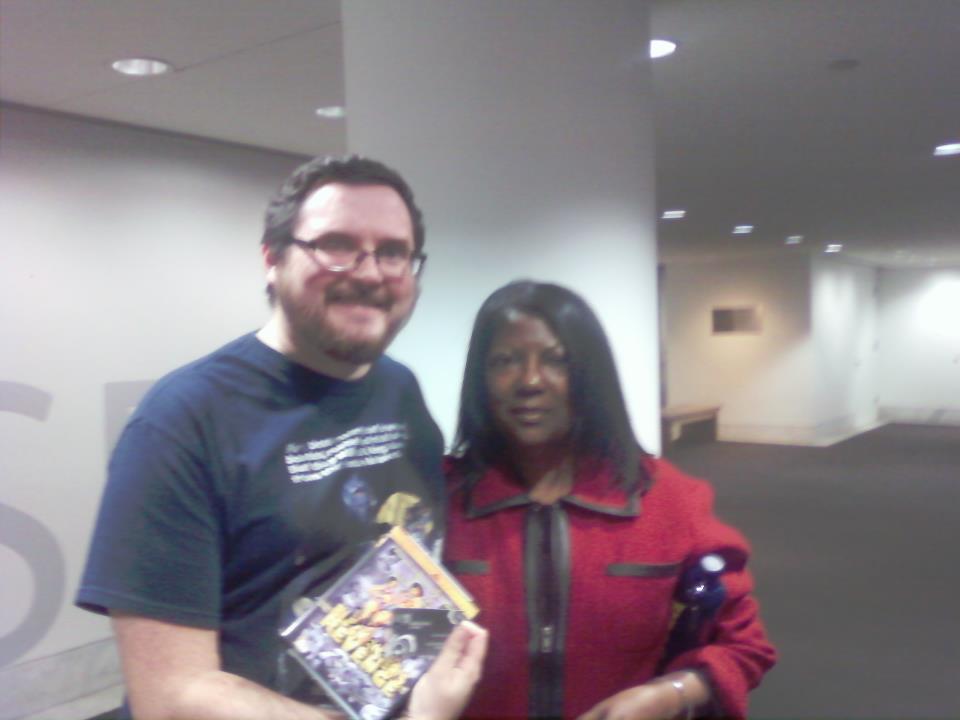
Like I said, I've seen "Emma Mae" once before in the theater, as well as "Welcome Home Brother Charles," "Penitentiary," & "Penitentiary 3;" all of which featured Mr. Fanaka in person, but this screening was extra special because not only was he present, but so were many of the cast members (Charles D. Brooks III & Synthia James), including Emma Mae herself, actress Jerri Hayes.


"Emma Mae" is a "moving picture," as Mr. Fanaka says, that has held up very well over time. Contrary to what the home video title, "Black Sister's Revenge," might suggest, "Emma Mae" is not your typical Blaxploitation Revenge film. From the beats and rhythms of the opening scene which captures a real life community spending the day at the park, the film feels different. It's clear in the opening minutes that Mr. Fanaka is a man who realizes the power of his camera, and that he has something to say.


An important component to fully appreciating the work of Fanaka is understanding how his early films were made. He is the only student of the prestigious UCLA film program to have no less than 3 features made and distributed while attending the University. While having access to UCLA's equipment, it is important to recognize what "Emma Mae" truly is, an ambiguous Independent film. In the same way he gained access to an abandoned jail house and masked a UCLA parking lot as a prison courtyard for "Penitentiary," Fanaka makes the most of every local he can for "Emma Mae."


The story of "Emma Mae" is that of a young naive girl from Mississippi (home of Mr. Fanaka) who moves to Southern California to be with her Uncle's family after her Mother passes away. In what was described at the screening as a "migration story," "Emma Mae" is about the difficult adjustment Emma must make to her new surroundings, combating others expectations of her, and to some extent, the equality of the sexes. Upon arriving by bus, Emma is quickly introduced to her cousins' world of friends, including Jesse & Zeke, a lanky, charming drug addict and his somewhat goofy partner.

(Left: Big Daddy, Zeke pictured on the right in the stylish hat)

When Jesse and Zeke find themselves wanted by the law, enamoured Emma holds up with them in the house of Big Daddy Johnson, a character similar to 'Seldom Seen' Jackson in "Penitentiary," who imparts a sort of elder wisdom to the youth of the film. When the cops imprison Jesse and Zeke, Emma does her best to lead a communal effort to save them. She literally fights, hustles, and robs to raise the money to get Jesse back. When he is finally released his true colors are revealed and he finds out that Emma is more than he ever imagined.


This screening was very special for many of the folks on stage, some of which, like Miss Jerri Hayes, had not scene the film on the big screen in over 30 years. After the movie, Hayes commented that it was better than she remembered, a common reaction to one's own work. Some time removed always softens one's self-criticism. I also spoke to Mr. Fanaka after the screening and he was ,as usual, a pleasure. It was nice seeing "Emma Mae" in an academic setting, in the same way it was nice to see it recognized by Turner Classic Movies a while back.

Jamaa Fanaka is an unsung auteur of Exploitation Cinema who continues to be rediscovered and appreciated everyday. "Emma Mae" is his crowning achievement.

Heather had her picture taken with Billy Wilder.


And I had mine taken with "Emma Mae."


--Popkoff

"Emma Mae" screened at the UCLA Hammer Museum on Dec. 16th, 2011 as part of the L.A. Rebellion: Creating a New Black Cinema - Film Series.

Monday, December 12, 2011

San Diego


Well, I moved to San Diego for the love a woman, and because there's gold in these hills. Currently, I'm looking for a job, but when I find one I will begin my exploration of this beautiful city.

I've been pretty busy since my last post over a year ago. I made a short film with a couple friends, called "Never Leave the House."


I also co-founded an Independent Film Series in Austin, TX called Cinema41 with some friends. We're still very small, but we're getting some traction.

Like I said, I've been busy. San Diego is a new adventure for me. Maybe I'll actually suceed in chronicling it this time.

--Popkoff