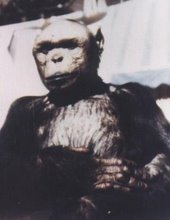
Well, I enjoyed this, mostly. When I sat down to watch it I had no idea it was a S.E. Hinton adaptation, but knowing that now, it make sense. It was updated to modern times, which is to say, the early 80's, which I suppose soured it in the minds of a lot of Hinton fans. I can understand that. Some movies age well, others not so much. "That Was Then" for the most part has aged well, but there are a few scenes that are very hoaky, especially the sequence near the end where Emilio Estevez is being chased by the cops, not sure what was going on there. Really, the first 2/3rds are very solid, the last act though teeters between underwhelming and cheesy, and then in the last sequence, it completely succumbs to it's dairy-inclination. A few tidbits: There's a really great scene involving the song "Jingle Bells." The film stars Craig Sheffer of "Nightbreed" & "Voyage of the Rock Aliens." It also has Larry B. Scott, also known as the gay guy from "Revenge of the Nerds." It's funny because there's a particularly awkward scene where Scott freestyles a rap while driving with Estevez & Sheffer (they provide the audience responses). The films representation of Hip Hop isn't much better than it's concept of Punks. Also, Morgan Freeman is totally in this movie.
"We Need To Talk About Kevin" is a film made up of memories and dreams. The narrative is fragmented, the spaces and times shift with the length of Tilda Swinton's hair. She is Eva, the mother of Kevin, and wife of Franklin (John C. Reilly). Kevin may or may not be evil and Eva may or may not be crazy, but they are linked together from birth, whether they want to be or not, and the film does a good job of maintaining a certain amount ambiguity in it's depiction of their relationship. The audience spends much of the movie piecing together not only the story, but the realities that the characters perceive. "Kevin" is one of those movies whose plot is actually quite simple, but it unfolds in an intentionally deceptive way. Some audience members will be turned off by that, and some will telegraph the resolution well in advance, but that's the point. The pieces are all there, the movie is just putting them together. As a result though, some people might find the ending underwhelming, but if there's one thing I've learned from watching movies, it's that most of the time the best ending is the most obvious. I liked the movie a lot, even in spite of the nearly year-long hype I had for it. It is perhaps a little too stylish, but I have a feeling that it will age well, and upon future viewings, the style will not be so distracting.
I enjoyed this very much. It of course had the promise of early Tim Burton on it's side, but there was also a Speilberg-ian quality to it, maybe that was aided by the presence of Barret Oliver (who always makes me think of 'The Twilight Zone Movie'). Great cast.
I'll keep this one short. This looks like a movie and sounds like a movie, but it doesn't feel authentic in any way. Steve Carrell and Tina Fey never seem like real people. From the opening scenes, their marriage feels fake and the plot feels forced. They merely seem like actors pretending to be married. The sad truth about "Date Night" is that it's one of those movies that you want to like because you know that there is potential for a good movie in it, but that ultimately disappoints (like so many modern offerings). I chuckled a few times, but it was not consistently funny. There was one inspired action sequence, and a few scenes where Carrell and Fey have chemistry, despite not having characters. The plot at times requires the audience to not ask questions like "why wouldn't you just tell the cop that those cops are crooked?" When it was over I told my girlfriend that I thought it would of been better if it was made in the 1980's, or even the 90's, if that makes any sense. It wants so badly to be something as good as "Adventures in Babysitting."
Paul Rudd and Jennifer Aniston play a young married couple who ditch their lives in New York and move to a hippie commune in the country when Rudd suddenly finds himself without a job. The movie is directed by David Wain and it toes the line between mainstream fare and the surreal absurdity he and his cronies (Michael Showalter, Michael Ian Black) are known for. Ken Marino ("Children's Hospital") wrote it and has a supportive role as Rudd's obnoxious successful brother. The first act of the movie is very economical and uses the quick beats of the narrative to it's advantage, especially in the sequence illustrating the cross-country car ride Rudd and Aniston undertake while moving to Atlanta. The first 2/3rds of the movie in general is very solid, the last act feels a little long, but it has a nice resolution. The cast is filled with great players all-around and some of them are really swinging for the fences here, namely Aniston, Alan Alda, and the great Justin Theroux (who is virtually unrecognizable in the film). It might also go without saying, but Rudd is really in his element here, and has a few scenes that are absolutely classic and rest solely on his shoulders. Overall, "Wanderlust" was a fun time at the movies.
What a curious little film this is, it's a slow moving train, but I thought it was worth the ride. At times it felt like a soap opera and other times like a taunt revenge film. Talia Shire plays a psychologist named Dianne Cruise who sets out on an emotional journey similar to Bill Murray's in "Broken Flowers," revisiting her old flames trying to gain some-sort of understanding of herself through her past relationships. The first 20 minutes is a little rough, but once John Belushi enters the film, as one of her exes still trying to live out his Rock 'N' Roll fantasies from high school, things really start to pick up.
The sequences of Belushi performing with his band are very interesting. Also, the scene in-which Dianne tries to sleep with him is possibly the best scene in the movie. It's a strange film, especially considering how the acts play out, with each one being better than the last. The third act revolves around Dianne meeting the disturbed younger brother of one of her exes played by Keith Carradine. When she finds out that his brother died 10 year prior, a strange Hitchcockian love story unfolds.
"Old Boyfriends" was c0-written by the great Paul Schrader and Leonard Schrader and directed by Joan Tewkesbury. The cast is rounded out by Richard Jordan and P.J. Soles of "Rock 'N' Roll High School" fame. It's not available on dvd or Netflix, but is on VHS and currently uploaded to YouTube (though it's a bit fuzzy, but watchable).
Well the Oscars are over and the post-show criticisms are in. Like the Oscars themselves, there is nothing new under the sun criticism-wise, at least not in the media coverage. With every passing year though I notice a lot more apathy and sarcastic criticism of the ceremony within my circle of movie-nerd friends. With the avalanche of Facebook status updates filled with baiting-opinions presented as facts overloading my news-feed this past week I felt unbelievably lame for looking forward to and actually enjoying the Oscars. So what is it that makes our opinions so different? We are all around the same age, share similar tastes, and above all, have an appreciation for the art of film-making.
Some of the common complaints I hear are that the ceremony is too predicable, too long, and too boring. It's just one big self-congratulatory celebrity love-fest and that it doesn't really matter because it doesn't really represent the "best" movies of the year. It's all hype, and above all, the aspect of the ceremony that really gets their goat is that the Academy never picks the right films (i.e. the ones they want to win). Fair enough.
Here are my thoughts on the subject. In a lot of ways I think the Oscars are like the Superbowl for film-nerds, a whole years worth of build up, speculation, and over-analyzing resulting in a winner that is usually unsatisfactory for most of the fans. The winner is usually predictable, the coverage is extra long, and depending on the competitiveness of the teams, the game can be boring.
Unlike the Oscars though, people love the Superbowl. No one is made to feel lame for watching it and those few souls who actually do hate it are probably the kind of miserable assholes who complain about everything (trolls). Despite usually being a huge disappointment, every year, people still look forward to the Superbowl, hell, they even look forward to the freaking commercials. To hear certain detractors spin it, you would the Oscars were being mercilessly labored through by the audience, with each additional commercial adding an extra excruciating 30-45 seconds of wasted time to the viewer's life. Despite the fact that the ceremony is rich with tradition, only comes once a year, and is a celebration of the medium that they love most, these folks seem to be hellbent on undermining the importance of it.
Ah yes, the importance of it. Are the Oscars as important as the Academy wants you to believe? No, but they are not meaningless either. I'm not sure if you've observed a casual film-goer recently, but I have had plenty of exposure to them working at the theater. Here are a couple of my insights into the mind of the average (age 15-25) film-goer: A) If it wasn't made in the last 5 years, it might as well never have existed, and B) a lot of people (especially young people) never consider exactly how movies are made or where they come from. A lot of the kids that worked at the theater with me seemed to think that movies were just new stories being churned out to them every week, no thought given to the idea that people make movies and that's there's an artistry and craftsmanship to it.
This is where The Oscars come in to play, maybe not for young people who don't even watch basic television anymore, much less award shows, but for let's say, society in general. For many reasons the modern movie industry seems to think of themselves as a business first and an art-form second (actually it's probably more like forth or fifth). As a society we're encouraged to think of movies as merely entertainment and not, you know, the greatest form of idea conveyance and documentation in our history. I know that last statement is a lightning rod for a lot of people who champion the written word, but I mean no offense. I'm not saying movies as a medium are necessarily better than literature, but rather, that it has the potential to be. It's a fascinating, magical storytelling medium and an incredible form of historical documentation that is treated like frivolous amusement by most people, but...not at the Oscars.
The "Road to the Oscars" is possibly the only time of year that mainstream media coverage acknowledges that there is more to the movies than box office results, that there is something to be said for art and, you know, films being good. For one night out of the year, there is a ceremony that takes movies seriously, that not only accounts for the technical aspects of the craftsmanship, but also reminds us that movies are part of our history, culture, and that yes, they are important. Even though, to me, it seems like a small gesture in the grand scheme of things, to many people it's perceived as this gaudy, lavish, and undeserved celebrity circle-jerk. For many, the idea that people in the film industry get any recognition, much less awards for their work when they've already received so much money as compensation is uncalled-for.
Yes, actors make a lot of money (although a lot of technical award winners involved in the process make much less and do deserve recognition), but comparatively to what some of these movies make, it's a fraction of the profits and in a lot of cases they are very much responsible for the revenue of the film (Johnny Depp in "The Pirates of the Caribbean" films springs to mind). Plus, I'm not sure if you've notice, but there's not much money at the box office in "good" movies these days. The reason I bring that up is because actors (and studios for that matter) need motivation to make films that might not necessarily make a lot of money, and the potential of an Academy Award is not a bad goal.
So what else? Oh yeah, the Oscars doesn't really represent the "best" movies of the year. Well, no shit, it's hard to please everyone when you're picking only one thing. That being said, look at the musical equivalent, The Grammys. The Grammy nominees over the last 20+ years have represented some of the most generic, unimaginative, and unauthentic examples of music imaginable; the most radio-friendly bullshit you can find.. If it sold, it's gold as far as the Grammys are concerned. Juxtapose that with the Oscars who since the mid-1990's have seemingly made a conscience effort to include lesser known films. They regularly get shit for nominating films that "no one's ever heard of" from one segment of the population and get even more shit for not nominating "Drive" from another segment. So yeah, "The Artist" might not have been the "best" film of 2011, but if the Oscars were like the Grammys, they would of picked "Transformers: Dark of the Moon" instead, so you're welcome.
In conclusion, the Oscars are far from perfect, in fact they're kind of a mess these days. So many people complain about them that the producers have repeated tweaked the formula, experimented with new "modern" ideas, and shifted back and forth between tradition and what they think people want. It never seems to please anyone. So why defend the Oscars?? Maybe because no one else ever does? Nah, I just love movies and I love the idea of the Oscars. I want it to be better and I'm going to keep watching hoping for those little pieces of spontaneous moments and emotion that make it work. I sometimes think about the 1996 Awards, a year in-which much was made about "the year of the Indie film," and I think about how little I care about the Best Picture nominees from that year (with the exception of "Fargo") now. The thing I remember from that show was the Cuba Gooding Jr. acceptance speech, which everyone remembers. It was the kind of moment that only the Oscars could produce.
This is my life in San Diego, CA: Where Culture is the only thing that's Cheap. This blog is hopefully going help me keep track of how many movies I'm watching. I'll also use it to share music that I'm really enjoying at the moment.