Showing posts with label 1970's. Show all posts
Showing posts with label 1970's. Show all posts
Monday, July 2, 2012

Wednesday, June 13, 2012
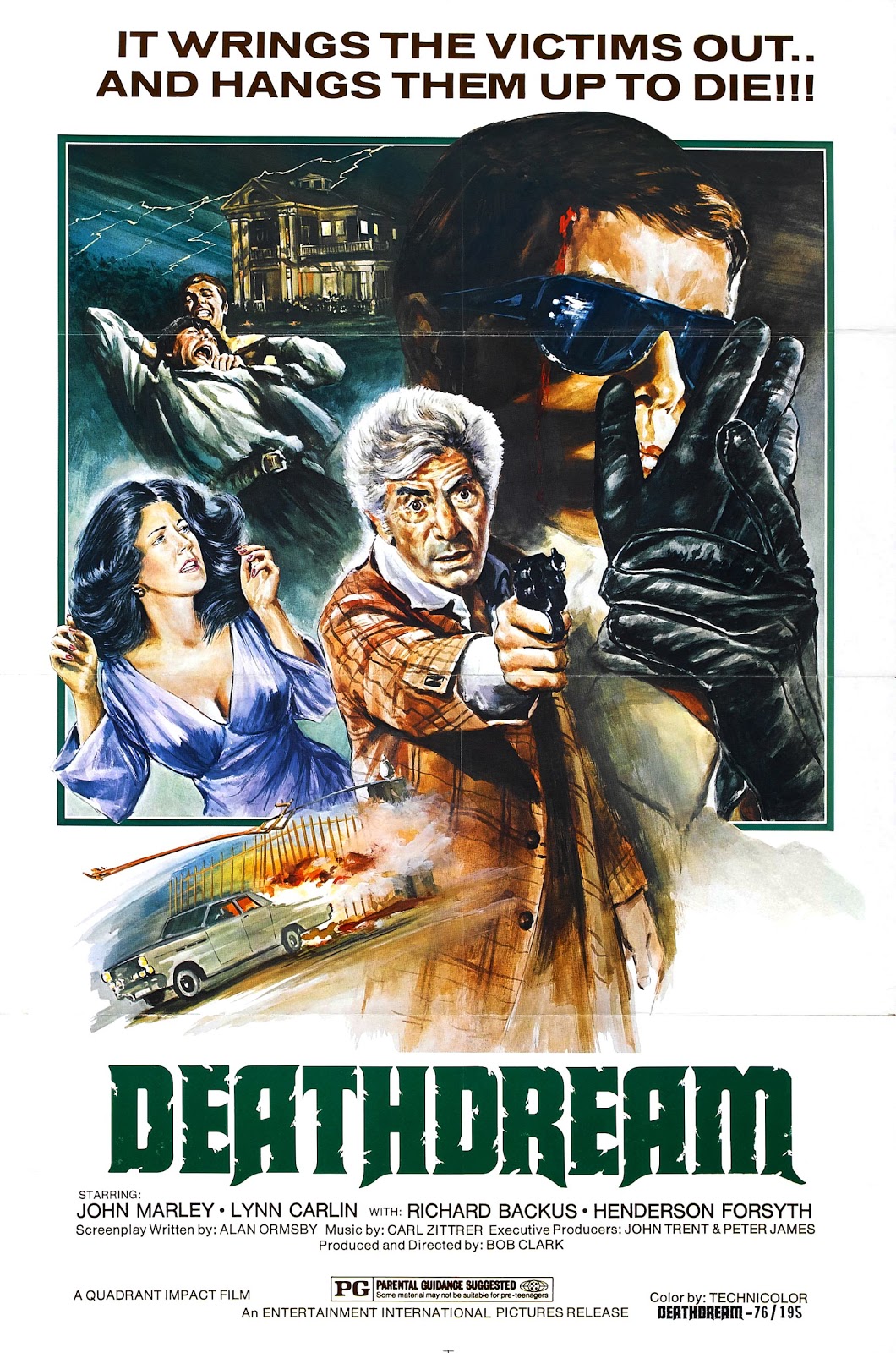
The Silent Partner (1978)

Re-watch: Showed this to some new friends, it's easily in my Top 10 Favorite movies. I could watch it once a week and never tire of it.
Sunday, March 25, 2012
Tracks (1977)
 What a strange little trip this one turned out to be. Dennis Hopper plays a soldier in-charge of ensuring the safe transport of his fallen friend's body back home to be buried. He accompanies the body back home by train. Virtually the entire film take place on a train which is always a fun experiment.
The movie at times radiates that raw naturalistic style so often used in the 70's, but at other times is dreamlike and surreal. Hopper is great in the film as usual. My only real complaint I suppose stems from the final scene, which seems to be almost improvised. That aspect of it is not what bothered me as much as the fact that the scene just stops and the credits roll without really allowing the story to resolve one way or the other. Normally that sort of thing doesn't bother me because it leaves me with the feeling that there was much more going on in the film, but with "Tracks," I felt that the lack of resolution signified that the was actually less. I felt that the creative did not have a resolution in mind and couldn't come up with one. Maybe I'm wrong, but I'll probably never know.
--Popkoff
Charley Varrick (1973)

Wow, what a smooth little crime film this is. Two of my favorite bad-asses, Joe Don Baker & John Vernon, play the villains in this tale of a small-town bank robbery that coincidentally results in the ripping off of $750, 000 of Mafia money. The "lucky" bank robber is played by Walter Matthau of all people, whose mere presence casts a slightly goofy feel to this otherwise gritty little caper.

Matthau is really good overall and the film itself is just so well executed. I think John Vernon is one of the most underrated characters ever, he has two wonderful scenes in the movie, one in which he subtly threatens Mr. Roper from "Three's Company" while pushing a little girl on a swing, and another in-which he ponders the joy of being a cow while subtly threatening the bank manager of the bank that was robbed. The real star of the movie though is Joe Don Baker as a cool, cold-blooded hitman hired to track and kill Matthau whose named Molly. He is excellent in this movie.

-- Popkoff
Friday, March 2, 2012
Old Boyfriends (1979)
 What a curious little film this is, it's a slow moving train, but I thought it was worth the ride. At times it felt like a soap opera and other times like a taunt revenge film. Talia Shire plays a psychologist named Dianne Cruise who sets out on an emotional journey similar to Bill Murray's in "Broken Flowers," revisiting her old flames trying to gain some-sort of understanding of herself through her past relationships. The first 20 minutes is a little rough, but once John Belushi enters the film, as one of her exes still trying to live out his Rock 'N' Roll fantasies from high school, things really start to pick up.
 The sequences of Belushi performing with his band are very interesting. Also, the scene in-which Dianne tries to sleep with him is possibly the best scene in the movie. It's a strange film, especially considering how the acts play out, with each one being better than the last. The third act revolves around Dianne meeting the disturbed younger brother of one of her exes played by Keith Carradine. When she finds out that his brother died 10 year prior, a strange Hitchcockian love story unfolds.
"Old Boyfriends" was c0-written by the great Paul Schrader and Leonard Schrader and directed by Joan Tewkesbury. The cast is rounded out by Richard Jordan and P.J. Soles of "Rock 'N' Roll High School" fame. It's not available on dvd or Netflix, but is on VHS and currently uploaded to YouTube (though it's a bit fuzzy, but watchable).
--Popkoff
Thursday, February 9, 2012
Rancho Deluxe (1975)

This somewhat forgotten young-Jeff Bridges vehicle about renegade cattle rustlers was a surprisingly fun way to spend 90 minutes. The joy of the film for me was the beautiful scenery and the slew of wonderful performances by a cast comprised mostly of character actors. The film got off to a slightly slow start, I think perhaps because of my limited understanding of what these guys were up to. After about 20 minutes though, I was hooked by the performances, not only from Bridges and Waterston, but also from a couple young actresses that I'm was unfamiliar with, Patti D'Arbanville and Maggie Wellman as sisters.
The plot centers around two easy-going, fun-loving guys, Jack and Cecil (Bridge and Sam Waterston) who are up to no good, rustling (illegally killing/stealing cattle) the local livestock-tycoon, John Brown's (played by the wonderful Clifton James) product. Jack and Cecil continually (and anonymously) up the ante on Mr. Brown; stealing his prize bull, $50,000 of his money, and by plotting the massive theft of a truckload of cattle.

Mr. Brown and his wife initially rely on the help of Burt and Curt (Richard Bright and Harry Dean Stanton) to try to figure out who is ripping them off. As the plot unfolds, Curt figures out who the rustlers are and, in probably the most interesting sequence of the movie, confronts Jack about his illegal activity over a game Pong. The two forge an alliance and agree to work together to deceive Mr. Brown.

Mr. Brown then enlists the help of Henry Beige (played by Slim Pickens), a former thief-turned-livestock-detective to solve the mystery. Beige brings along his daughter, Laura (Charlene Dallas), who quickly draws the attention of Curt. Curt's attraction to Laura proves to be his Achilles's Heal.

A couple other stray observations: In some ways, "Rancho Deluxe" reminded me of "Freebie and the Bean" because Sam Waterston plays a Native American, despite being really really caucasian, much in the same way Alan Arkin plays a Hispanic in "Freebie." Also, as in "Freebie," Jeff Bridges spends most of his time in "Rancho" make racist remarks toward Sam Waterston...it's just plain weird.

Waterston's father in the movie is played by the wonderful Joe Spinell. Also, the film is directed by Frank Perry, who also made "Ladybug,Ladybug," a little known film from the 1960's about the staff and students at a rural school who react to a broadcasted warning of an imminent nuclear attack, not knowing whether it is real or a mistake. I think that will one of my next viewings.
--Popkoff
Saturday, January 28, 2012
Glen and Randa (1971)

This bizarre post-apocalyptic oddity was apparently critically well-received when it was initially released, although you couldn't guess that based on the current IMDB rating, which is in the low 3's. I don't think it was nearly that bad, in fact it's kind of aged well. Perhaps that's mostly due to the entertaining, and unintentional goofy performance of the lead actor, Steve Curry, sporting Sideshow Bob-style hair.

The film was originally rated "X" for the amount of nudity (and imagine some of the situations), and of course, it's seems relativity tame now. The story is pretty simple, Glen and Randa are teenage lovers (and Adam and Eve metaphors) in a future with no hope, they head out into the unknown in search of the Metropolis of D.C. Comics fame. Along the way they meet a horse, Glen violently kills some non-CGI fish, and they meet a old man who aides with the birth of their child.
I enjoyed this, probably won't watch again anytime soon, but if it were to screen somewhere, I'd take in.
Also, one of my favorite tidbits was Glen's insistence on labeling everything he learns about.

--Popkoff
Saturday, January 14, 2012
Slithis...Returns

The first post I ever made on this blog was about the 1978 shlock horror film "Spawn of the Slithis." I still think of this movie to this day, it is just such an absurd, weird piece of trash cinema. It's really really funny and charming in its own way. Anyway, the whole movie is on youtube so I thought it would be nice to post it here.
If you want to recreate the what it was like to see this movie at drive-in in the late 70's, check out the "SLITHIS SURVIVAL GUIDE."


--Popkoff
Monday, January 2, 2012
Faves of 2011: Film Edition

Favorite Films of 2011:
"Hugo" - Dir: Martin Scorsese
In general, I haven't been a huge fan of the Dicaprio-era of Marty Scorsese's career, but there have been exceptions of course ("The Departed" & the underrated "Shutter Island)". "Hugo" is a film that, for better or worse, is a love letter to cinephiles. It's practically a memorial to the traditional magic of the cinema, crafted in the digital 3D aesthetic of our time. I'm curious to see what the future holds for this Martin Scorcese character.

"Drive" - Dir: Nicolas Winding Refn
Much was made of the sparse dialogue, odd musical selection, and lack of car chases in "Drive," but the reality of it is that those same criticisms are what sets it apart from every other movie. There's not much new in "Drive," if anything, but it's unique style and execution stuck with me after I saw it. The romantic plot-line was stripped down to it's barest bones, quietly punctuating how unnecessary dialogue really is when your story is made up of familiar scenarios like these. It works though, in the same way the violence does; the minimalism creates a maximum effect. Also, Albert Brooks is amazing in this.

"Super 8" - Dir: J.J. Abrams
We live in a world with ever-shortening attention spans. It used to seem as if it wasn't made in the last 5 years it wasn't worth remembering, but sadly it seems as if that unfortunate rule-of-thumb is shrinking. Out of date films & music are becoming more obsolete to the average viewer at a faster pace than ever. With that in mind, 2011 was a good year for appreciating "old things," you know, like, the 80's. Just like "Hugo," the main story of "Super 8" is underscored by a fond affection for old school movie magic. Abrams' Spielberg homage to the days where monsters were less seen than heard manages to succeed on the shoulders of it's young, mostly unknown cast. Though they are sparse, there are plenty of loud clanks and explosions in "Super 8," but it's the quiet tender moments (Joe falling in love with Alice as she pretends to be a zombie) that are truly exhilarating.

"Martha Marcy May Marlene" - Dir: Sean Dirken
The feature length debut of Dirken features a fascinating breakthrough performance by the least known Olsen Sister, Elizabeth, as Martha, a woman who escapes a dangerous hippie cult (or does she). John Hawkes is once again perfectly cast as a Charles Manson-type ringleader, but so too is Sarah Paulson, in the under-appreciated role of Lucy, Martha's (and really, everyone's) concerned, more successful sister. The genius of "MMMM" is that it consistently leads the audience in one direction and then wisely shifts away from their most obvious expectations of any given scene. This narrative strategy works all the to the final, gut-punching shot of the film. When the credits role, you'll hear a loud audible grown from the audience, but what you'll feel is the same frustration of Martha, the anxiety of the unknown.

"The Artist" - Dir: Michel Hazanavicius
The most overrated movie of the year? Perhaps, but it's still one of the best. More than a gimmick, "The Artist" is a tough sell, a mostly silent, black & white film, presented in a 4:3 aspect ratio, and featuring two unfamiliar stars. The fact that it's been well received by audiences, much less critics is a true testament to it's special brand of nostalgia. Like I said, it was a good year for appreciating the past, even the Great Depression. Like "Hugo," "The Artist" is about the history of cinema, but it's specifically about technological change (a topic explored before in "Sunset Blvd."), and the difficultly that people sometimes face while adjusting. As a guy who loves 35mm film and doesn't want to see it go away, these days are hard for me as every multiplex is seemingly working hand-in-hand with the studios & projector companies to force Independent, 35mm screening theaters out of business. In that regard, "The Artist" spoke to me as a someone who is finding technological change difficult.

Favorite Films DISCOVERED in 2011:
"White Dog" (1982) - Dir: Samuel Fuller
Caught this bad boy for FREE thanks to Austin Cinemateque. Co-written by Curtis Hanson ("L.A. Confidential") who got the job based on his script for one of my absolute favorite films, "The Silent Partner," "White Dog" famously fell victim to a timid studio and a fear-induced frenzy of unfounded racial outrage over the subject matter. As a result, the allegorical tale of an attack dog taught to hate black people, and the fight that ensues to save it's life by reteaching it, did not get a theatrical release until 1992 (not sure what exactly changed in that 10 years). "White Dog" is film filled with blood-fueled passion and gladiatorial intensity, crafted by an American master of matter-of-fact film-making.

"Road to Salina" (1970) - Georges Lautner
The strange and beautiful tale of rail-thin Jonas (Robert Walker Jr.), a drifter who finds himself taken in by gas station owner, Mara (Rita Hayworth!!), a woman who believes him to be her dead son. Playing the role to take advantage of her hospitality, Jonas' situation is complicated by the arrival of his "sister," Billie (played by the always hot Mimsy Farmer). He enters into a seemingly natural sexual relationship with her and that is just the beginning of the awkward uncomfortableness of "Road to Salina." The beautiful cinematography and excellent SOUNDTRACK only add to this dazzling, under-seen gem.

"Trouble Man" (1972) - Dir: Ivan Dixon
Robert Hooks plays a force of nature named Mr. T, a man of means, intelligence, and most of all, coolness. His role as a "fixer" lands him right in the middle of warring gangs and police. With all sides closing in, T is the man who must fight to clear his name. Fortunately for him, his smooth demeanor is his best weapon. Stylistically "Trouble Man" has more in common with something like John Boorman's "Point Blank" than a typical Blaxploitation outing. A sleek production though doesn't detract from the authenticity of the characters and feel of the film, in part due to the amazing Marvin Gaye soundtrack.

"Metropolitan" (1990) - Whit Stillman
I love the look, feel, score, and clothing of this film. It's hard to sell the idea of yuppies hanging out being interesting, but it's just a very clever and charming collection of episodic parties, played out night after night. Just when the formula wears out it's welcome, the third act hits and leaves you with a feeling whimsy and a strange absurdity. So Great.

"Chameleon Street" (1989) - Wendell B. Harris Jr.
The reputation of the Sundance Film Festival is that unless you win the Grand Jury Prize, you're pretty much screwed with regards to distribution. So what do you do when you actually win and still can't get distribution? If you're Wendell B. Harris Jr., you fight a 20 year war to get your film seen by the masses. "Chameleon Street" won the Grand Jury Prize at Sundance in 1990, but has had a difficult road since, which is beyond unfortunate considering how incredibly good it is. Based on the true story of Douglas Street, a con artist who consistently exploited other's expectations of him, faked being a reporter, a lawyer, and even a doctor, successfully performing surgery. Harris both directs and stars in the film, which is appropriate because although it is based on the life of someone else, Harris re-invents himself as Douglas Street and the film says as much about him as it is Street.

--Popkoff
Sunday, December 18, 2011
Emma Mae (1976)

"Nobody celebrates at Jack in the Box."
Last night Heather & I made our first trip to L.A. since we moved to San Diego. We went to the Hammer Museum, home of the Billy Wilder Theater, to see the great Jamaa Fanaka's 1976 masterpiece, "Emma Mae." It was my second time seeing it in a theater, plus it was a brand new 35mm print, presumably cut for a new DVD release in the near future (hopefully under it's original title). Heather had never seen it, but neither of us are strangers to the wondrous Mr. Fanaka. He's a born entertainer, and his Q&A's are really something special.

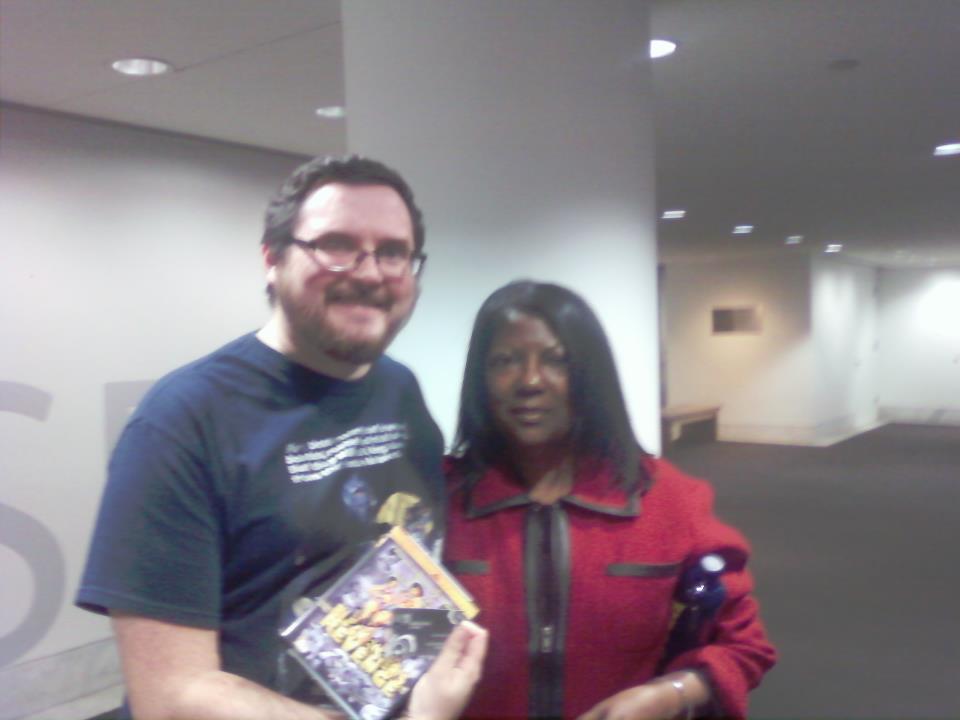
Like I said, I've seen "Emma Mae" once before in the theater, as well as "Welcome Home Brother Charles," "Penitentiary," & "Penitentiary 3;" all of which featured Mr. Fanaka in person, but this screening was extra special because not only was he present, but so were many of the cast members (Charles D. Brooks III & Synthia James), including Emma Mae herself, actress Jerri Hayes.

"Emma Mae" is a "moving picture," as Mr. Fanaka says, that has held up very well over time. Contrary to what the home video title, "Black Sister's Revenge," might suggest, "Emma Mae" is not your typical Blaxploitation Revenge film. From the beats and rhythms of the opening scene which captures a real life community spending the day at the park, the film feels different. It's clear in the opening minutes that Mr. Fanaka is a man who realizes the power of his camera, and that he has something to say.

An important component to fully appreciating the work of Fanaka is understanding how his early films were made. He is the only student of the prestigious UCLA film program to have no less than 3 features made and distributed while attending the University. While having access to UCLA's equipment, it is important to recognize what "Emma Mae" truly is, an ambiguous Independent film. In the same way he gained access to an abandoned jail house and masked a UCLA parking lot as a prison courtyard for "Penitentiary," Fanaka makes the most of every local he can for "Emma Mae."

The story of "Emma Mae" is that of a young naive girl from Mississippi (home of Mr. Fanaka) who moves to Southern California to be with her Uncle's family after her Mother passes away. In what was described at the screening as a "migration story," "Emma Mae" is about the difficult adjustment Emma must make to her new surroundings, combating others expectations of her, and to some extent, the equality of the sexes. Upon arriving by bus, Emma is quickly introduced to her cousins' world of friends, including Jesse & Zeke, a lanky, charming drug addict and his somewhat goofy partner.
 (Left: Big Daddy, Zeke pictured on the right in the stylish hat)
When Jesse and Zeke find themselves wanted by the law, enamoured Emma holds up with them in the house of Big Daddy Johnson, a character similar to 'Seldom Seen' Jackson in "Penitentiary," who imparts a sort of elder wisdom to the youth of the film. When the cops imprison Jesse and Zeke, Emma does her best to lead a communal effort to save them. She literally fights, hustles, and robs to raise the money to get Jesse back. When he is finally released his true colors are revealed and he finds out that Emma is more than he ever imagined.

This screening was very special for many of the folks on stage, some of which, like Miss Jerri Hayes, had not scene the film on the big screen in over 30 years. After the movie, Hayes commented that it was better than she remembered, a common reaction to one's own work. Some time removed always softens one's self-criticism. I also spoke to Mr. Fanaka after the screening and he was ,as usual, a pleasure. It was nice seeing "Emma Mae" in an academic setting, in the same way it was nice to see it recognized by Turner Classic Movies a while back.
Jamaa Fanaka is an unsung auteur of Exploitation Cinema who continues to be rediscovered and appreciated everyday. "Emma Mae" is his crowning achievement.
Heather had her picture taken with Billy Wilder.

And I had mine taken with "Emma Mae."
--Popkoff
"Emma Mae" screened at the UCLA Hammer Museum on Dec. 16th, 2011 as part of the L.A. Rebellion: Creating a New Black Cinema - Film Series.
Tuesday, December 9, 2008
Redneck (1973)
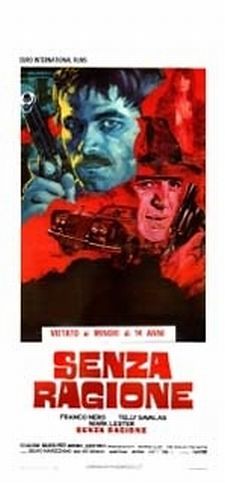
“Redneck" was not the Southern-set rural Hicksploitation flick that I thought it was going to be, but rather an Italian-made crime-gone-awry film starring Franco Nero and Telly Savalas as Mosquito and Memphis respectively. The two of them play jewel store robbers who in process of getting away (via an outrageously crazy car chase sequence) accidentally kidnap a young boy named Lennox (Mark Lester of “Oliver” fame). Lennox is an effeminate lad who is in disparate need of a father figure, so much so that he projects that need onto Mosquito. Nero's performance is one of confusion, repressed anger, and despair.
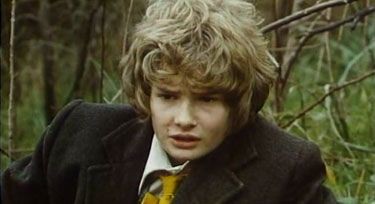
Telly's Memphis on the other hand is in a different world entirely; he's a hayseed chewing, spiritual singing caricature that has more in common with Robert Downey Jr's performance in “Tropic Thunder” than with any 'redneck' I've ever met. He shoots a kid, assaults a prostitute, and kills a German family in the middle of their picnic, and all the while hysterically maintains his innocence to God, claiming repeatedly that it wasn't his fault, and that they made him do it.
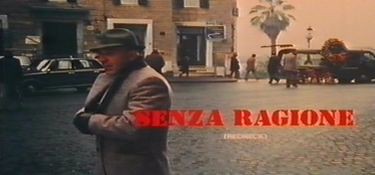
By the end of the film Franco Nero is completely fucked up, shivering in the snow, covered in filth and blood, and forced to wear a woman's Tiger-skin jacket. Lennox and him are reduced to dragging a wounded Memphis through the woods and across the snow in an attempt to reach the border. All the while, Memphis suffers near-death hysteria as his crotch is covered in blood, and the police zero in on them. This movie is so crazy that the final gun battle involves a person being shot by bullet that causes them to perform a cartwheel before quietly exiting this world.
Overall, "Redneck" is a surprisingly good Thriller that's really worth checking out for Savalas' bizarro performance.
Tuesday, November 11, 2008
The Shape of Things to Come (1979)
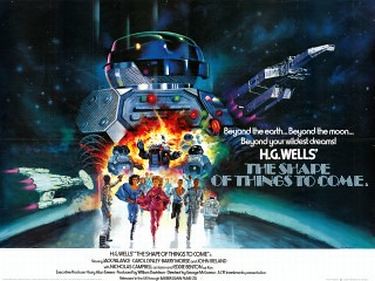
So I can safely say that this unfaithful H.G. Wells adaptation was a pretty unmemorable Weird Wednesday, especially considering that it screened a mere month ago, and sitting here now, I'm struggling to recall what I thought about it. I guess what I'm saying is bear with me on this one.
The plot, as provided by imdb.com goes something like this:
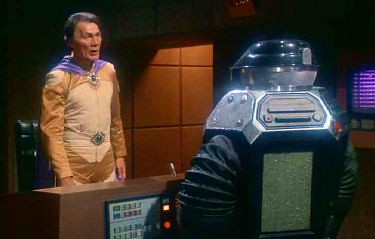
Planet Earth is a devastated wasteland, and what's left of humanity has colonized the Moon in domed cities. Humanity's continued survival depends on an anti-radiation drug only available on planet Delta Three, which has been taken over by Omus (Jack Palance), a brilliant but mad mechanic who places no value on human life. Omus wants to come to the Moon to rule and intends to attack it by ramming robot-controlled spaceships into the domes. Dr. John Caball, his son Jason, Jason's friend, Kim, and a robot named Sparks embark on Caball's space battlecruiser on an unauthorized mission to Delta Three to stop Omus.
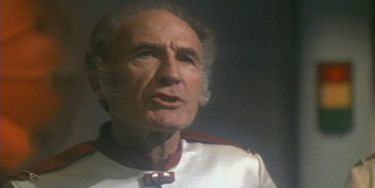
Now let me just say that reading this synopsis now, I guess I can see how a plot could be strung together by the scenes I saw, but at the time (perhaps it was my tired mental state, but I never fell asleep once during this one) I swear my mind was not processing a plot, but merely absorbing scene after scene.
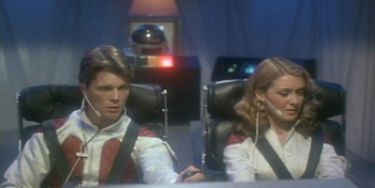
That being said, the most painful problems with the film are obvious from the get-go; the lumbering pace, the low production value (for a Sci-Fi film at least), and a completely flat script are among the film's worst crimes. The absolute worst though, without a doubt, is the complete under-use of the incomparable Jack Palance. He shows up briefly early on and you're primed for some damn fine scene-chewing, and then there's nothing for an hour or so. He shows up in the last 25 minutes or so to unload some pure cinematic insanity, but it's too little, too late.
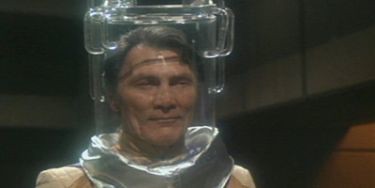
It wasn't a total loss though, there were some pretty laughable moments here and there, among my favorites:
--Jack Palance giant floating/rotating holographic head. His incredible overacting, arm gesturing, and his delivery of the line: “Where's your humanism now doctor!?!” You can also tell how evil he is by how many times he laughs out of pure amazement and delight with what he's doing.
--The hallucinogenic space travel sequence (something that seems to be a standard in 70's Sci-Fi films) that's capped with the line: “What the Hell was that about?”
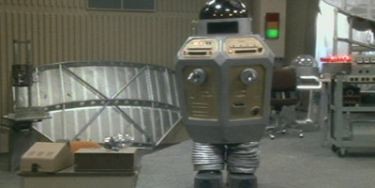
--The ridiculous "robots." Sparks actually seems more human than most of the humans in the film.
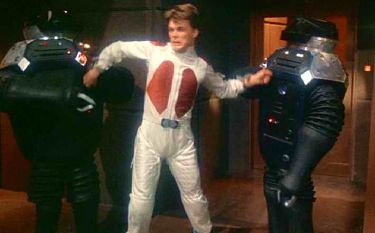
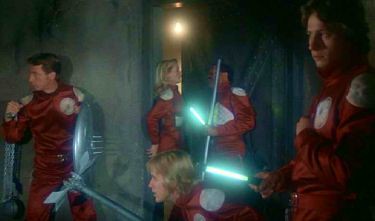
--The crazy space-gladiator weapons.
--There's a group of kids in the movie that are supposed to be mutants, or fallout victims, or orphans or something. I don't know, but half of them have on awful blond wigs. The other half have either naturally blond hair or just naturally dark hair. I'm pretty sure that the idea here was that they would all have blond wigs, but the filmmakers didn't have enough to go around so some ended up with them and some didn't. The only reason I think this is because one of the kids wearing a blond wig was Asian.
To be fair to this one, I know there were a lot of other funny bits, but I just can't remember them. I leave you with this, did you know that Jack Palance's birth name was Volodymir Ivanovich Palahniuk? Me neither.
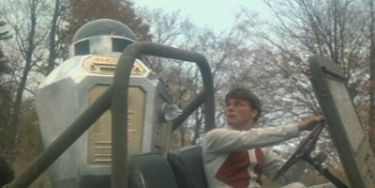
"The Shape of Things to Come" screened 10/8/08 at the midnight and was presented by Weird Wednesday.
Subscribe to:
Posts (Atom)